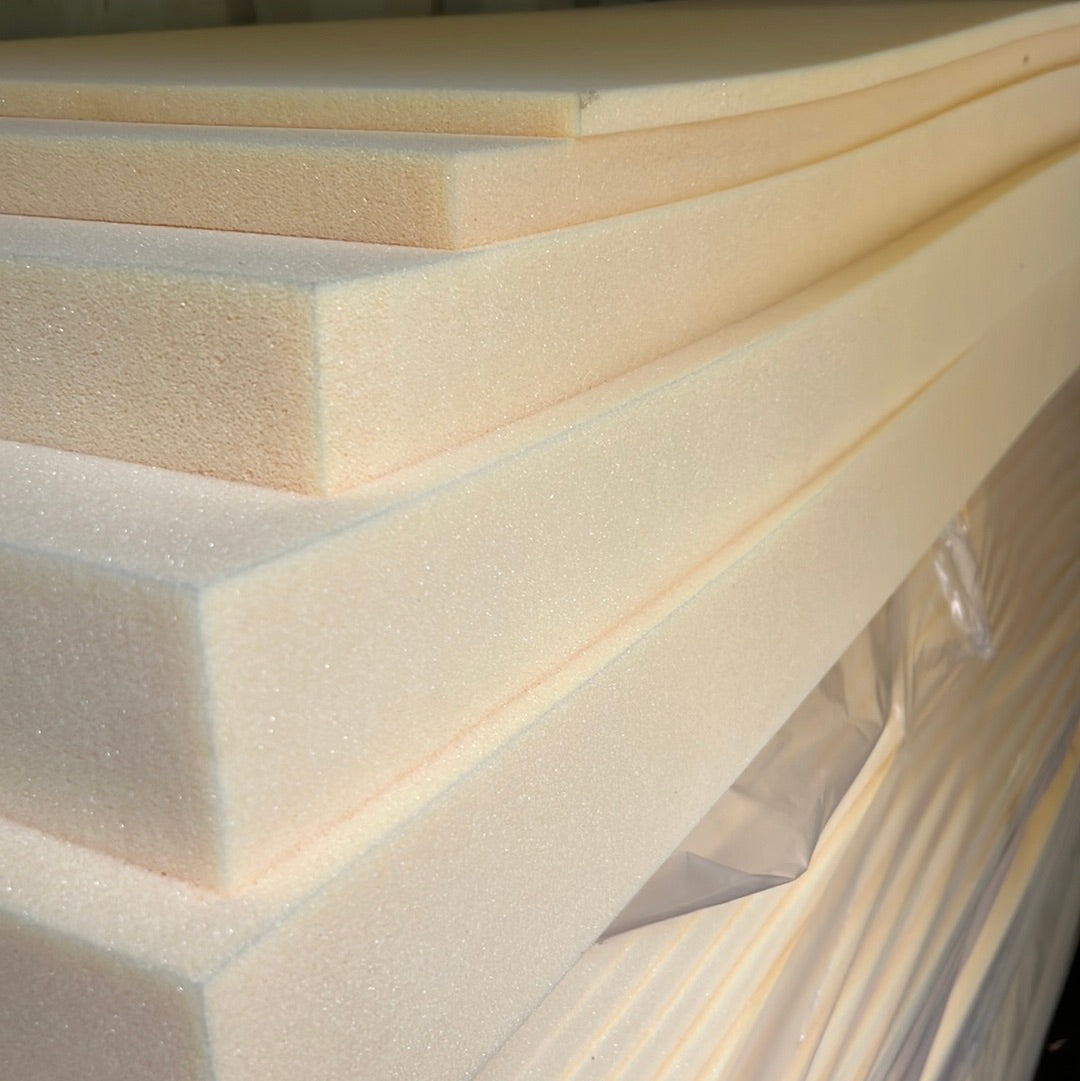
Thin foam does its best work where cushions need shape and some give without much height. At 1" thick, this sheet feels firmer than a thick cushion, since there's less foam to sink into. Here's where customers use it most:
- Dining chairs and kitchen chairs: A 1" pad adds comfort to a hard wood or plywood seat without making the chair look bulky.
- Benches and window seats: The 82" length covers most bench cushions in a single piece, so there's no seam across the seat.
- Headboards: Headboard padding gives you a softer surface to lean back on, and 1" is a perfect thickness for keeping the panel slim.
- Sofa and chair backs: Back cushions typically use thinner foam than seat cushions, and a 1" layer over a firmer core softens a sofa cushion.
- Truck seats: Upholsterers use HR30 to build up worn truck seats and restore lost height under a new upholstery cover.
- DIY projects and crafts: Ottoman tops, cornice boards, and padded panels use thin foam pads to soften edges before the fabric goes on.
How to Custom Cut Foam Pads to Size at Home
The 24" width fits a standard 18" x 18" seat pad with room to spare, so one sheet yields foam pads for up to four chairs plus an offcut for crafts. Measure the seat width and depth, trace the seat board onto the foam, and cut slightly outside the line so the cover pulls the foam snug.
A long, sharp blade or an electric carving knife gives a clean edge. Hold the blade straight up and down, guide it along a straightedge, and make steady passes in one direction instead of sawing. For a curved seat, make a paper template before you custom cut the foam. Shears and cutting tools are in our upholstery tools collection, and our upholstery adhesives include sprays that hold foam pads to the seat board so they don't shift under the fabric.
Choosing the Right Firmness for Seat Cushions
Firmness and density measure two different things. Firmness is usually given as ILD (indentation load deflection), the weight it takes to compress foam by a set amount. Soft foam falls around 10 to 16 ILD, while firm foam runs above 45. Lower numbers feel plusher, and higher numbers feel more supportive with less sink. Density measures how much material is in the foam and has more to do with how long cushions last.
HR30 sits in the middle, a balanced choice for chair foam pads and seat cushions that get daily use. For a stiffer base on commercial seating, choose the HR60 extra firm sheets in our upholstery foam collection. Many upholsterers layer thin foam pads over a firmer core for solid support with comfort on top. For boat cushions and outdoor seats, closed cell foam is a great fit because it resists moisture. You can also read about the different types of foam and where each works.
Midwest Fabrics has supplied upholstery materials to DIY customers and professional upholsterers since 1983. Order online or pick up at 1226 Concord St S, South St. Paul, MN 55075, Monday through Friday, 8am to 4:30pm. Customers can also request a foam sample to check the feel before ordering.